Timo (Johnny) Kärkkäinen (inspires papers) joined the group in August 20026 for the 2 year postdoc position within the MAPS project Bringing theory and experiments together for precision neutrino physics.
Timo (Johnny) Kärkkäinen (inspires papers) joined the group in August 20026 for the 2 year postdoc position within the MAPS project Bringing theory and experiments together for precision neutrino physics.
The essays grew out of a discussion on the French Physical Society (SFP-HEP) forum about climate change and future colliders, particularly the FCC. However, the discussion goes well beyond these specific issues, touching upon broader questions concerning the role and future of basic research in general:
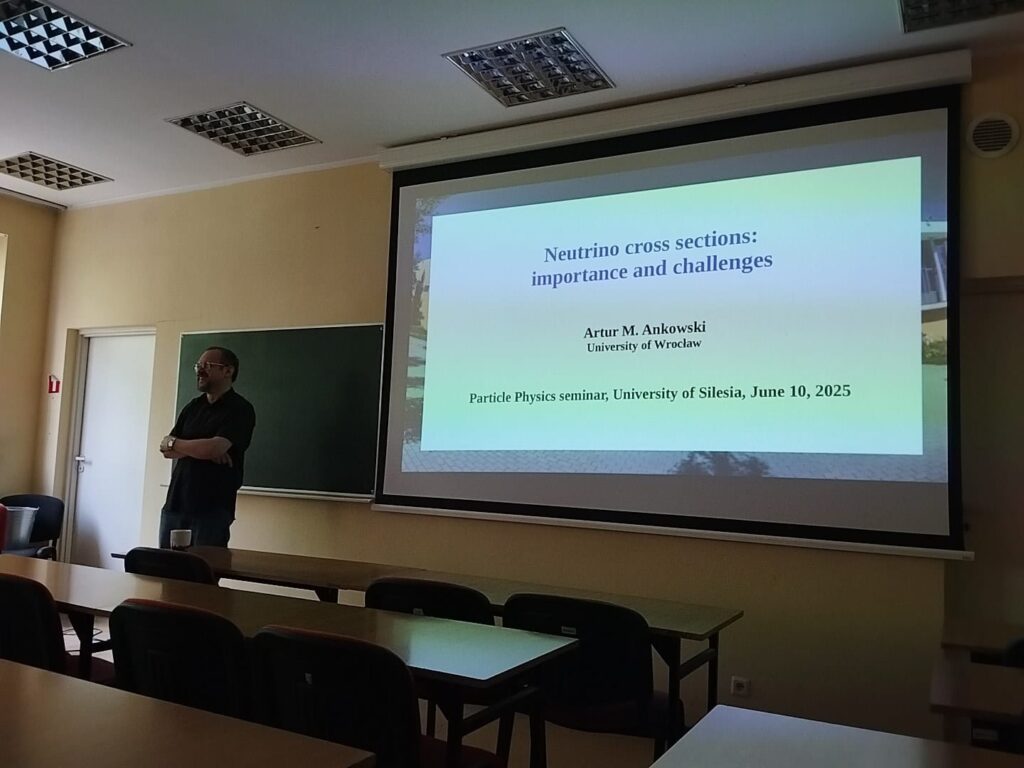
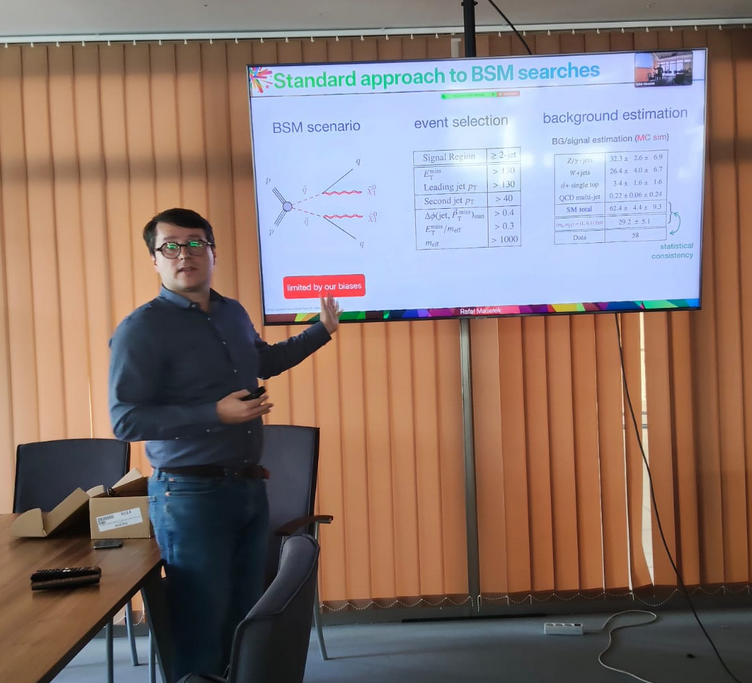
Dr Masełek (Stefan Institute, Ljubljana) visited our group and gave a talk on recent advances in machine learning, which have enabled new model-independent approaches to searching for physics beyond the Standard Model at the Large Hadron Collider. This method can be applied beyond HEP (pdf).
The first annual meeting of the multilateral project titled “Bridging Theory and Experiments: Pushing the Boundaries of Neutrino Oscillation Precision Physics” took place in Zagreb (link). Our group represented Biswajit Karmakar (talk Generalized parametrization of PMNS matrix based on SO(3) symmetry, pdf) Janusz Gluza (talk Neutrino oscillations in the context of discrete flavor models, pdf), Marek Michalczyk (talk Texture zero in neutrino mass matrices, pdf), Szymon Zięba (online talk Correlations in oscillation parameters, pdf) and Timo Kärkkäinen (online talk Non-standard interactions, pdf).
MITP Mainz organized a small workshop (participation by invitation – Janusz Gluza) on Electroweak Corrections at Current and Future Accelerators.
In Helsinki, the FCC Week took place. Janusz Gluza presented a talk for the FCC-ee Working Group “Precision Calculation for FCC-ee: Status Plans” (link, pdf).
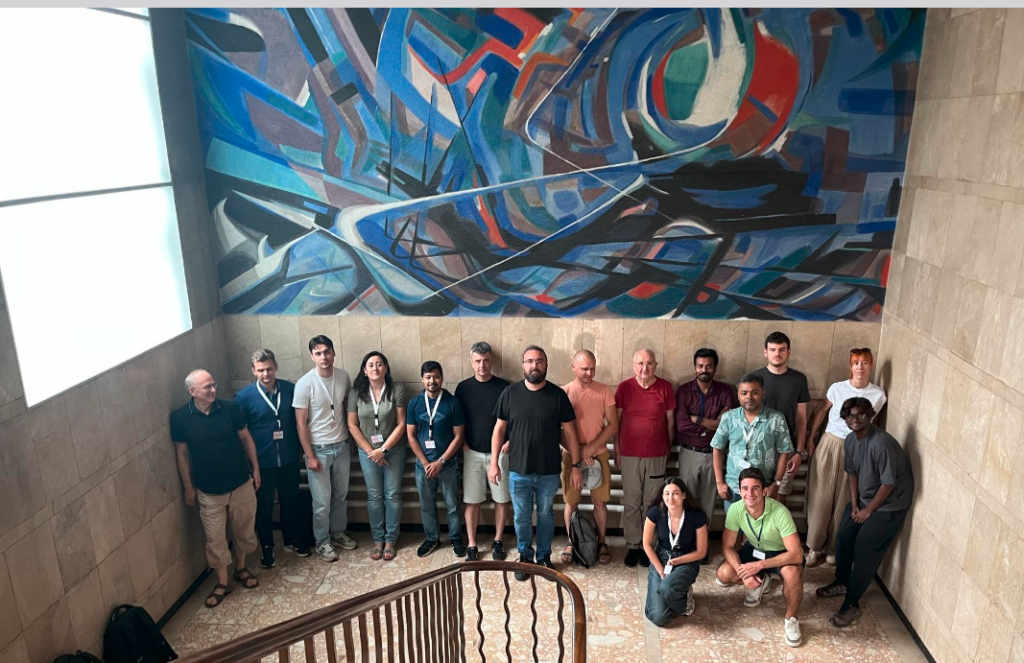
We hosted Prof. Monojit Ghosh from Rudjer Boskovic Institute: Zagreb, HR for a period 3-23 December 2025 within the MAPS project. He presented a seminar on Non-standard interactions at ESSnuSB experiment.
We started a new project entitled Bringing Theory and Experiments Together for Precision Neutrino Physics, with a total funding of CHF 774,883, financed in part by SNSF MAPS (Multilateral Academic Projects) program. Apart from our theoretical and experimental neutrino groups from the University of Silesia, the Polish-Swiss-Croatian collaboration involves scientists and researchers from the University of Geneva (Switzerland) and the Ruder Boškovic Institute (Croatia). Here is a short summary of the project: link.
The European Strategy for Particle Physics (ESPP) took place in Venice with talks and discussion on the future direction of European particle physics in the global context, for a programme, see https://agenda.infn.it/event/44943/overview
National input from members of the high-energy physics communities in CERN’s 25 Member States so far indicate broad support for the FCC programme on account of its outstanding scientific potential and long-term strategic value. From the summary talk by Calin Alexa (direct link https://agenda.infn.it/event/44943/contributions/265700/attachments/137706/207148/ESG%20WG1%20report%20v15.1.pdf)
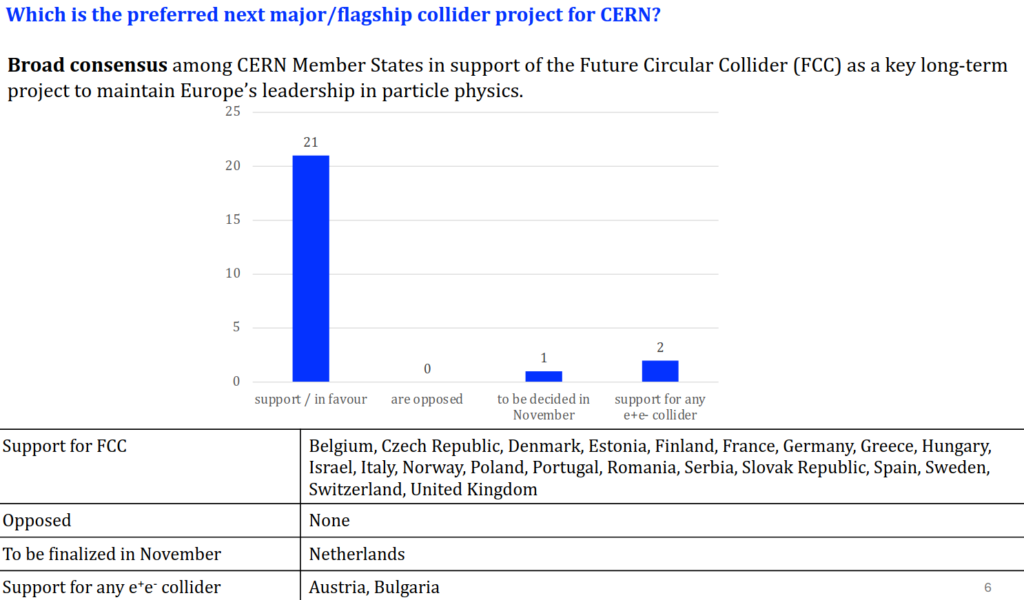
“I am happy to see that the recommendations of the 2020 ESPP update and their implementation via the FCC Feasibility Study enjoy overwhelming support from the vast majority of the high-energy physics community as well as leading experts,” said Costas Fountas, President of the CERN Council.
Input and recommendation by Poland, co-authored by Janusz Gluza: https://inspirehep.net/literature/2916518
A new project, Precision Studies for particle-collider physics, has received funding from Polish National Science Centre (~3.4 MPLN). The research mainly focuses on calculations and simulations using the Monte Carlo higher-order perturbation effects generators within the Standard Model of particle physics in current and future high-energy accelerators. These calculations will allow the verification of subtle effects predicted by extended theoretical models that attempt to answer still unexplained aspects of particle physics related to the interactions of Higgs particles and their impact on the evolution of the Universe with matter-antimatter asymmetry and the effects of CP symmetry violation, or the generation of masses and neutrino oscillations. The research will be conducted in cooperation with scientists from Germany, Hungary, Switzerland, Ukraine, the UK and the USA.
You can read more about the project on the website of the National Science Centre: https://www.ncn.gov.pl/sites/default/files/listy-rankingowe/2023-06-15-lut7739ikitila/streszczenia/595831-en.pdf
(in Polish:) https://www.ncn.gov.pl/sites/default/files/listy-rankingowe/2023-06-15-lut7739ikitila/streszczenia/595831-pl.pdf

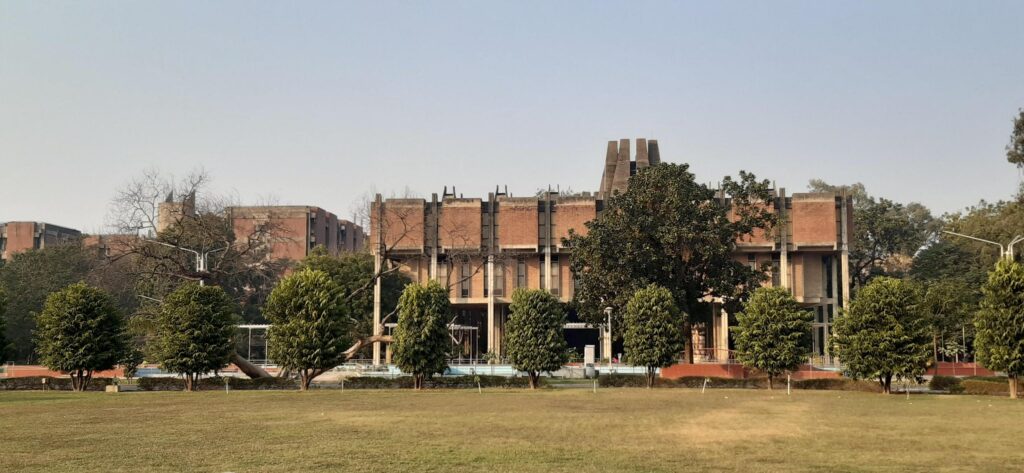
From November 21 to December 4, 2023 Bartosz Dziewit and Krzysztof Grzanka had a scientific visit to IIT Kanpur in India. The stay was part of the project realization: Minimal Left-Right Symmetric Model as an Effective Field Theory, Polish National Agency For Academic Exchange (Bilateral exchanges PL – INDIA).
As part of this agreement, they were guests in a group led by Dr. Joydeep Chakrabortty.

Janusz Gluza presented talks at the 6th edition of Silesian Science Festival KATOWICE on (quantum) vacuum and the 10th anniversary of the Higgs boson discovery.
We are happy to announce a new book by Ievgen Dubovyk, Janusz Gluza, Gabor Somogyi.
https://link.springer.com/book/9783031142710 , ISBN: 978-3-031-14271-0
Arxiv: https://inspirehep.net/literature/2593456

August 28 – September 8, 2022, Janusz Gluza and Krzysztof Grzanka participated in Corfu 2022, the Standard Model and Beyond workshop, and they gave talks which can be found here.

as in physics, sometimes it’s hard to get to the point.