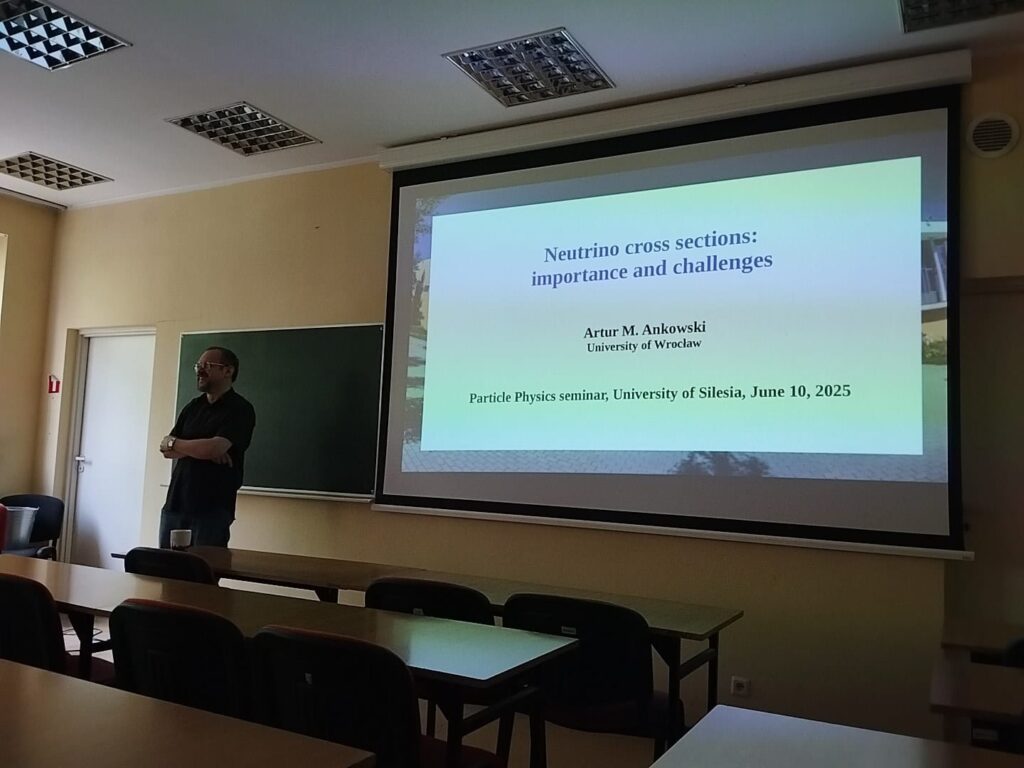
Timo (Johnny) Kärkkäinen (inspires papers) joined the group in August 20026 for the 2 year postdoc position within the MAPS project Bringing theory and experiments together for precision neutrino physics.
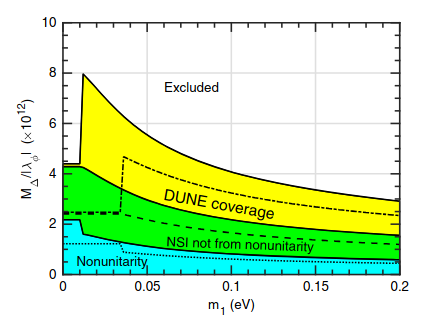
Timo (Johnny) Kärkkäinen (inspires papers) joined the group in August 20026 for the 2 year postdoc position within the MAPS project Bringing theory and experiments together for precision neutrino physics.
The essays grew out of a discussion on the French Physical Society (SFP-HEP) forum about climate change and future colliders, particularly the FCC. However, the discussion goes well beyond these specific issues, touching upon broader questions concerning the role and future of basic research in general:
The next step in the development of the FCC project is the Reference Design Phase and the assembly of the required materials, in preparation for a CERN Council decision on the future HEP machine, foreseen in 2028. Thus, there is a new organization of the FCC groups
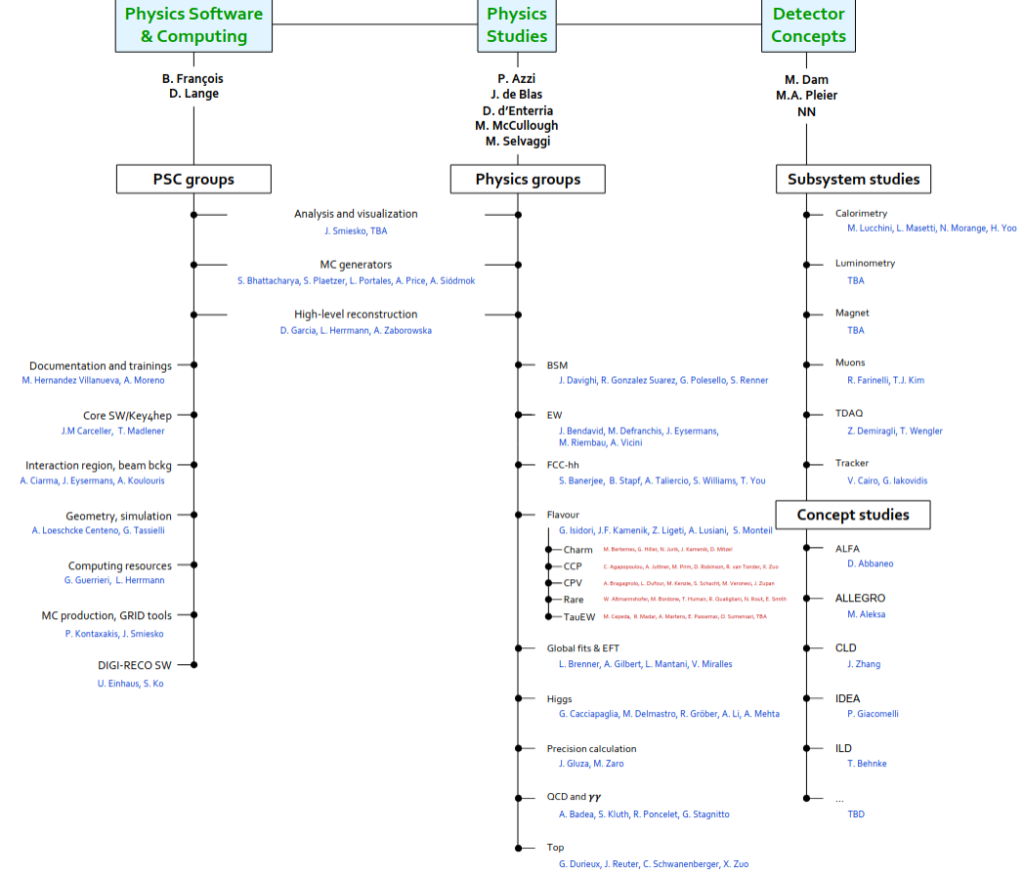
Janusz Gluza and Marco Zaro are conveners of the new Precision calculation subgroup. The mandate of the group covers various aspects of precision physics, including:
The activities of our subgroup are closely connected with those of other groups (MC generators, EW, Higgs, …), with which we envisage joint activities, such as (mini-) workshops, schools, etc.
For a full list of working groups, see https://gms.web.cern.ch/, where you can join our group (fcc-ped-physicsgroup-precisioncalculations). Here, you are directed to the group of your interest: https://indico.cern.ch/event/1663323/contributions/7010789/attachments/3256388/5812739/PED_egroups_chart_2026_03_21.pdf
In the Precision Calculation subgroup, we plan to organise talks and discussions on these subjects, with particular focus on new works and/or on topics in response to interests and needs raised by the community. Please follow the links to the events and talks here: https://indico.cern.ch/category/21380/
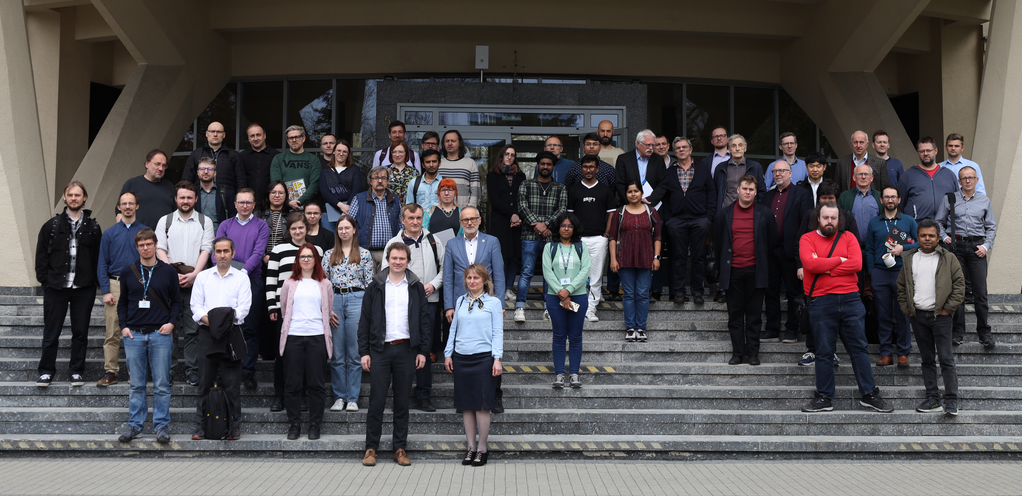
On 16th April 2026, we participated in the first Polish FCC workshop in IFJ Kraków. The strong attendance (76 registrants), active participation, and substantive discussions clearly showed the need for further integration of the community interested in the FCC programme. Here are details of the programme: https://indico.cern.ch/event/1663323/overview
In the work https://arxiv.org/abs/2603.06571, we have calculated quantum corrections to the muon decay lifetime, indirectly showing that the W-boson mass gets a correction from the 3-loop Feynman diagrams
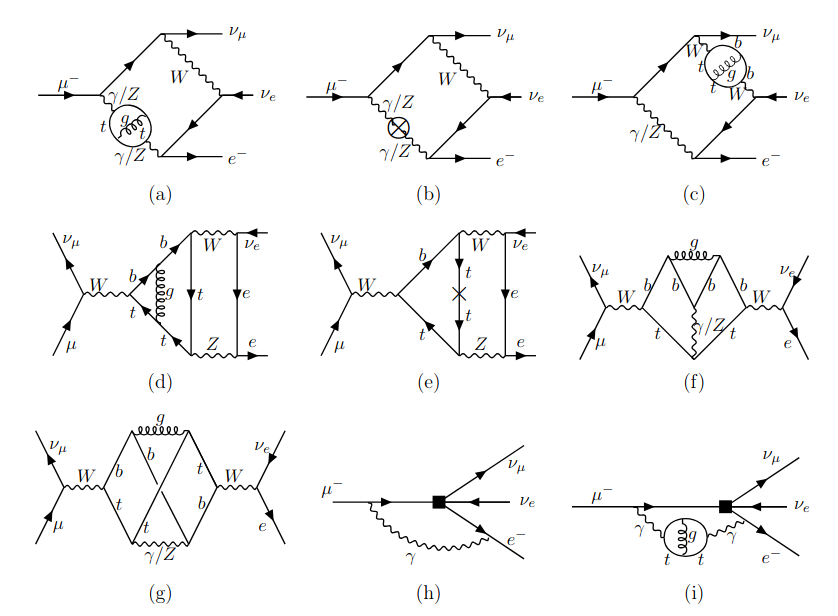
shifting its mass by +3.14 MeV. Have we reinvented the Pi number 🤔?
Comment by AI: https://gist.science/paper/2603.06571
The pattern of neutrino mixing, usually parameterized by the Pontecorvo-Maki-Nakagawa- Sakata UPMNS matrix, still remains a striking puzzle in particle physics. Why do we use the PMNS matrix?
We (Biswajit Karmakar and Janusz Gluza with Jarosław Duda from Jagiellonian University) discuss another parametrization of the neutrino mixing based on the SO(3) group, which is especially suitable for the CP-conserving case, with phenomenological consequences, in Physics Letters B article https://doi.org/10.1016/j.physletb.2026.140219
The mixing angles for parametrization based on the SO(3) group are quite different:
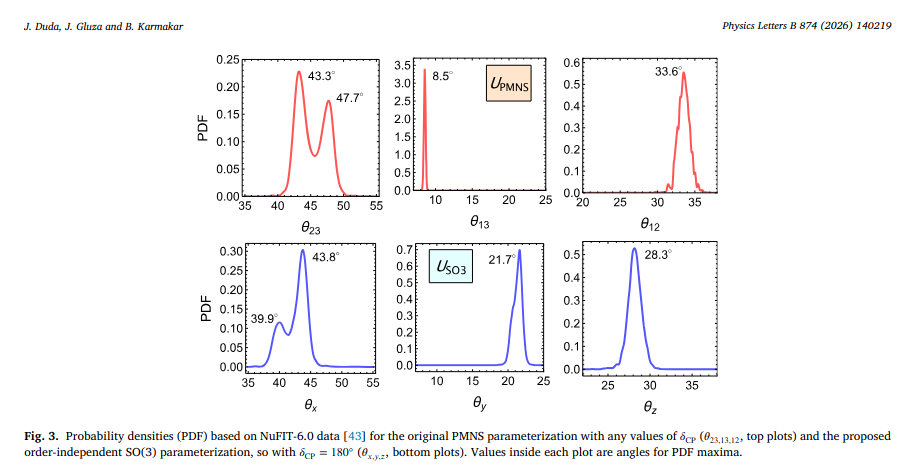
How is it possible? Think about it, or take a look at the article or the description at Gist.Science.
Two new NCN grants.
dr Nora Salone – „Precision studies of hadron production with CP violating and polarization effects at e+e- colliders within the BESIII collaboration”: 29 810 PLN.
Dr Salone cooperates with BESIII collaboration in China, recent talk from the MTTD conference.
dr Biswajit Karmakar – „Towards a Fundamental Theory of Flavor: Non-Holomorphic Modular Symmetry and Cosmological Probes”: 37 987 PLN. Dr Karmakar will collaborate with Prof. S. F. King from the University of Southampton, UK, publications.
The European Strategy for Particle Physics (ESPP) took place in Venice with talks and discussion on the future direction of European particle physics in the global context, for a programme, see https://agenda.infn.it/event/44943/overview
National input from members of the high-energy physics communities in CERN’s 25 Member States so far indicate broad support for the FCC programme on account of its outstanding scientific potential and long-term strategic value. From the summary talk by Calin Alexa (direct link https://agenda.infn.it/event/44943/contributions/265700/attachments/137706/207148/ESG%20WG1%20report%20v15.1.pdf)
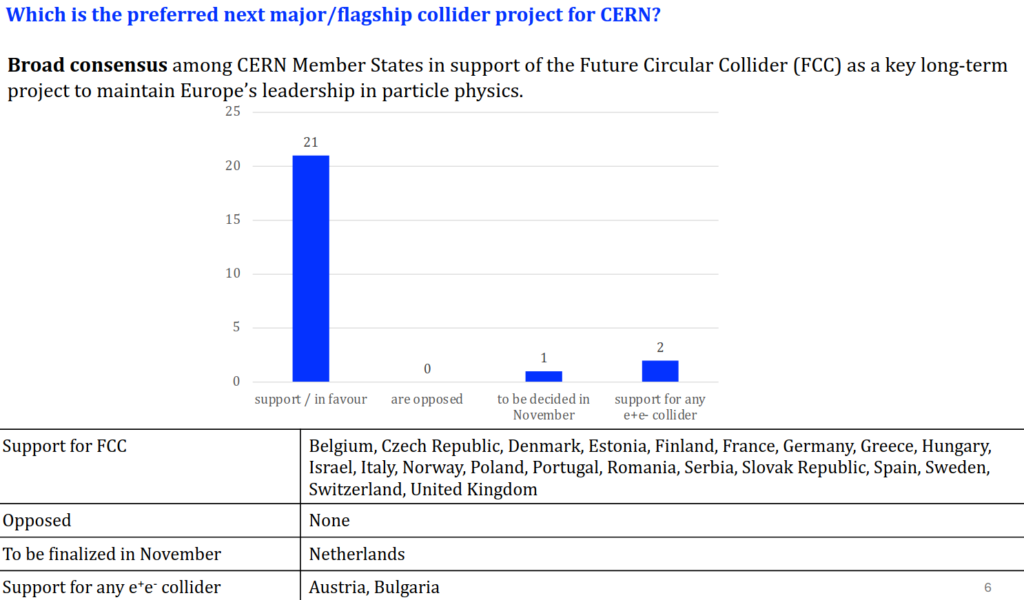
“I am happy to see that the recommendations of the 2020 ESPP update and their implementation via the FCC Feasibility Study enjoy overwhelming support from the vast majority of the high-energy physics community as well as leading experts,” said Costas Fountas, President of the CERN Council.
Input and recommendation by Poland, co-authored by Janusz Gluza: https://inspirehep.net/literature/2916518
On the occasion of Pi Day, organized by the Institute of Physics at the Silesian University as part of a scientific STAND-UP, Dr. Bartosz Dziewit delivered a lecture titled “Possibly Easily Digestible Physics and Its Surroundings. That is, among other things, about the role played by the smallest building blocks of the Universe in (my) understanding of its vastness and complexity.”
The lecture can be viewed on YouTube:
Prof. Jürgen Reuter from DESY visited us and presented a seminar on Heavy Neutral Leptons (HNL) at future lepton colliders — Intro to the Whizard MC generator on 04.02.2025
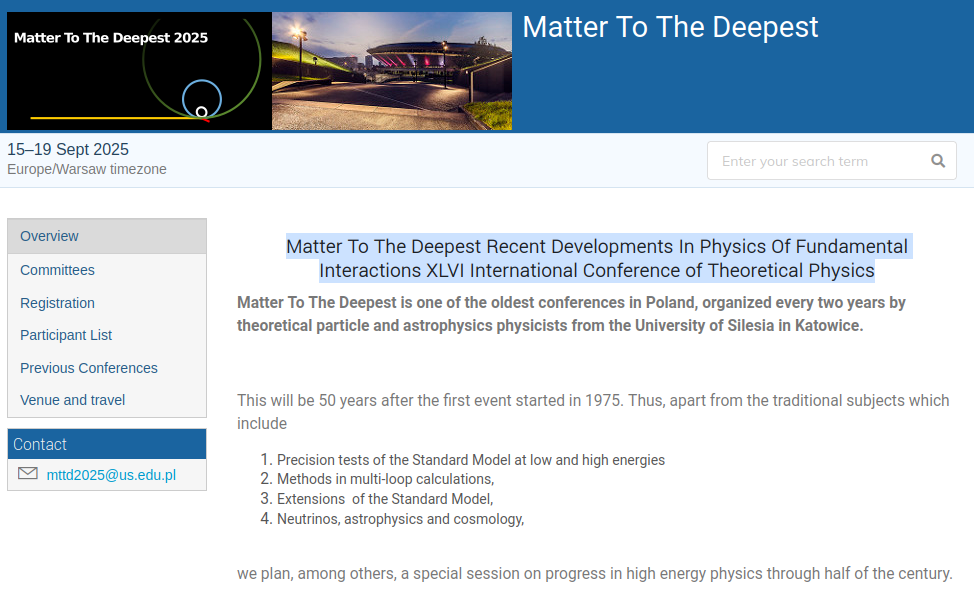
15-19 September 2025 we are organizing the next Matter to the Deepest conference (1975-2025)!
This time in Katowice. Details are here: https://indico.if.us.edu.pl/event/21/
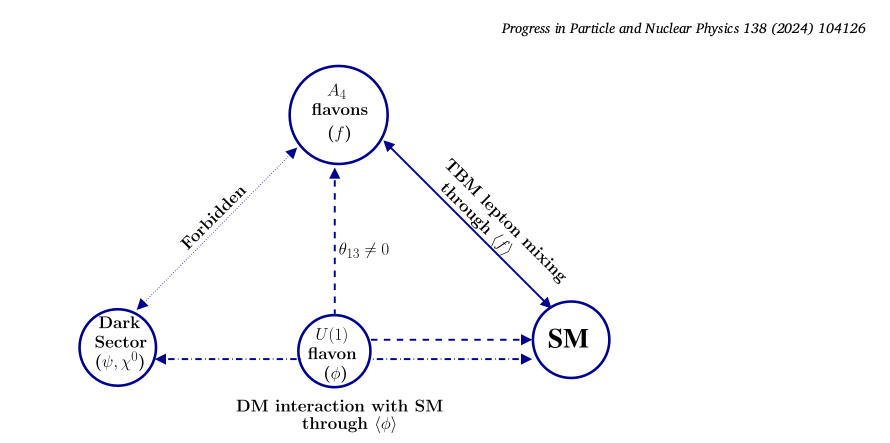
Our team in collaboration with scientists from the USA (University of Virginia and the Space Science Center of the University of Washington) and Germany (Max Planck Institute in Munich) published an article in the prestigious journal Progress in Particle and Nuclear Physics. The work concerns the analysis of models aimed at explaining what types of new symmetries can be used to understand the observed properties of oscillations of three types of neutrinos. The work considers so-called discrete symmetries, such as the A4 symmetry (such symmetries are used in physics, for example, to describe a diamond crystal) or more abstract symmetries based on modular groups https://en.wikipedia.org/wiki/Modular_group. These models imply the existence of new types of particles, which, in addition to describing the properties of masses and quantum mixing states of the known “flavors” of electron, muon and tau neutrinos, can also explain several cosmological observations such as matter-antimatter asymmetry in space (decays of new massive neutrinos) or the problem of dark matter (the paper considers implications derived from the interactions of spinless Higgs particles and additional fermions). The phenomenology of possible processes associated with discrete particle symmetries is very rich. Some symmetries are studied in particle colliders (e.g. LHC) or in the context of observing gravitational waves or exotic nuclear decays (e.g. neutrinoless double beta decay of nuclei). The work was carried out as part of the Opus grant of the National Science Centre “Non-standard neutrinos and CP-violating effects in the leptonic sector” (short description of the project in Polish: https://projekty.ncn.gov.pl/opisy/482538-pl.pdf). On the Polish side, the following participated in the work: Janusz Gluza (team coordinator), Szymon Zięba, Krzysztof Grzanka (PhD students), Biswajit Karmakar (postdoc), Ievgen Dubovyk, Bartosz Dziewit (assistant professors at the Faculty of Science and Technology, University of Silesia). Link to the work in the journal https://www.sciencedirect.com/science/article/pii/S0146641024000309 and the public version of the article in the Inspires HEP high-energy works repository https://inspirehep.net/literature/2715897
The University Newspaper features an interview with Janusz Gluza connected with a new NCN grant and particle physics in general, link
The 321st issue of the University Newspaper features an interview with Bartosz Dziewit titled: With what more will the Higgs boson surprise us?
From 8 to 12 January 2024, Janusz Gluza participated in the XXX Cracow EPIPHANY Conference giving a talk on: “Precision Physics at High Energy Colliders and Low Energy Connections”. More extended talk on the subject has been delivered at the Indian Institute of Technology in Guwahati, India (scientific visit 1-13 February 2024).



In October 2023, we welcomed a new member to our research team – Dr. Adam Bzowski, Inspires publications
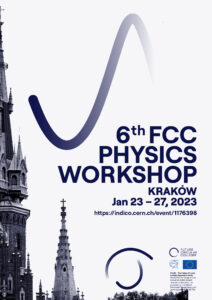
From January 22 to 27, 2023, members of our research group participated in the 6th FCC Physics workshop in Kraków.
Biswajit Karmakar gave a lecture on: “Z decay and heavy neutrinos at FCC-ee“
August 28 – September 8, 2022, Janusz Gluza and Krzysztof Grzanka participated in Corfu 2022, the Standard Model and Beyond workshop, and they gave talks which can be found here.

as in physics, sometimes it’s hard to get to the point.
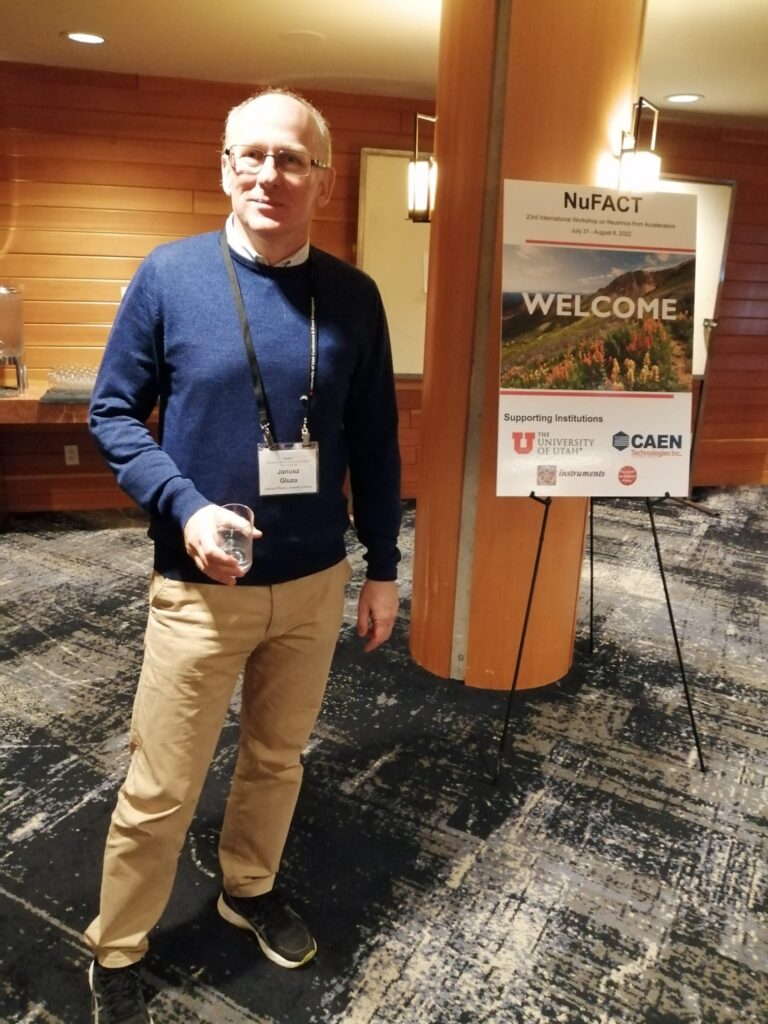
From July 30 through 6th August Janusz Gluza took part in NuFact 2022, chairing one of the plenary sessions and giving the talk “PMNS and the number of additional neutrino flavors” https://indico.fnal.gov/event/53004/contributions/243136/attachments/158351/207755/NuFact_2022.pdf. This conference was held in Snowbird, Utah, USA, and focused on neutrino physics and colliders. The twenty-third of the series of yearly international workshops started in 1999.


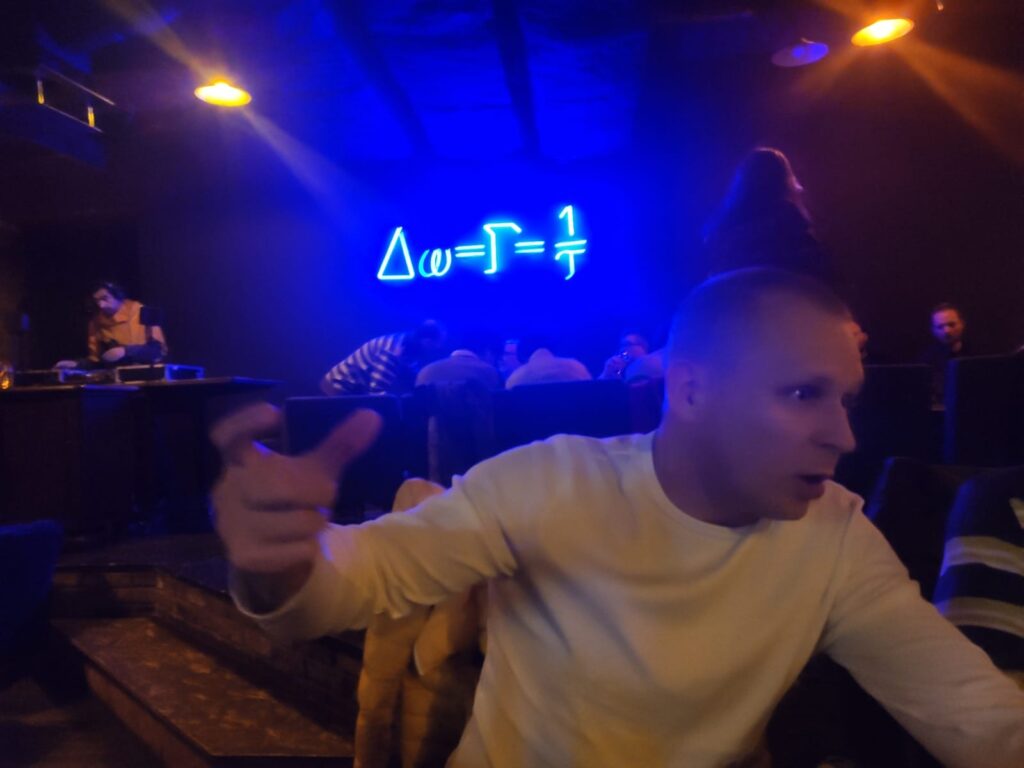
On October 21-23, 2022, the Symposium of the Fundamental Interactions Physics Section (SFOF) of the Polish Physical Society was held in Katowice. The symposium was organized in a hybrid form; 79 physicists participated in the event (6 online). During the symposium, in addition to the talks, a poster session was held, and the three best posters were selected. A group of participants spent Friday evening in the “Hipnoza” club, while on Saturday evening we got to know the Silesian Planetarium, which was renewed this year, Chorzów Park.
Details: http://indico.if.us.edu.pl/event/10/overview
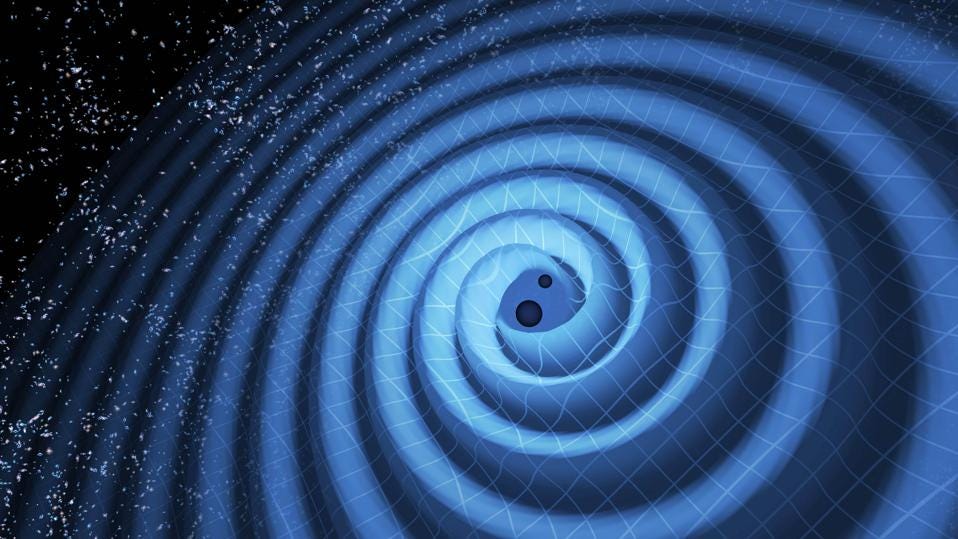
Janusz Gluza described what happened 10 years ago in the Large Hadron Collider – the first detection of the Higgs boson by ATLAS and CMS experiments – in a short popular article available in Polish on our institute webpage and in English https://us.edu.pl/wydzial/wnst/en/2022/07/01/10-rocznica-wykrycia-bozonu-higgsa/
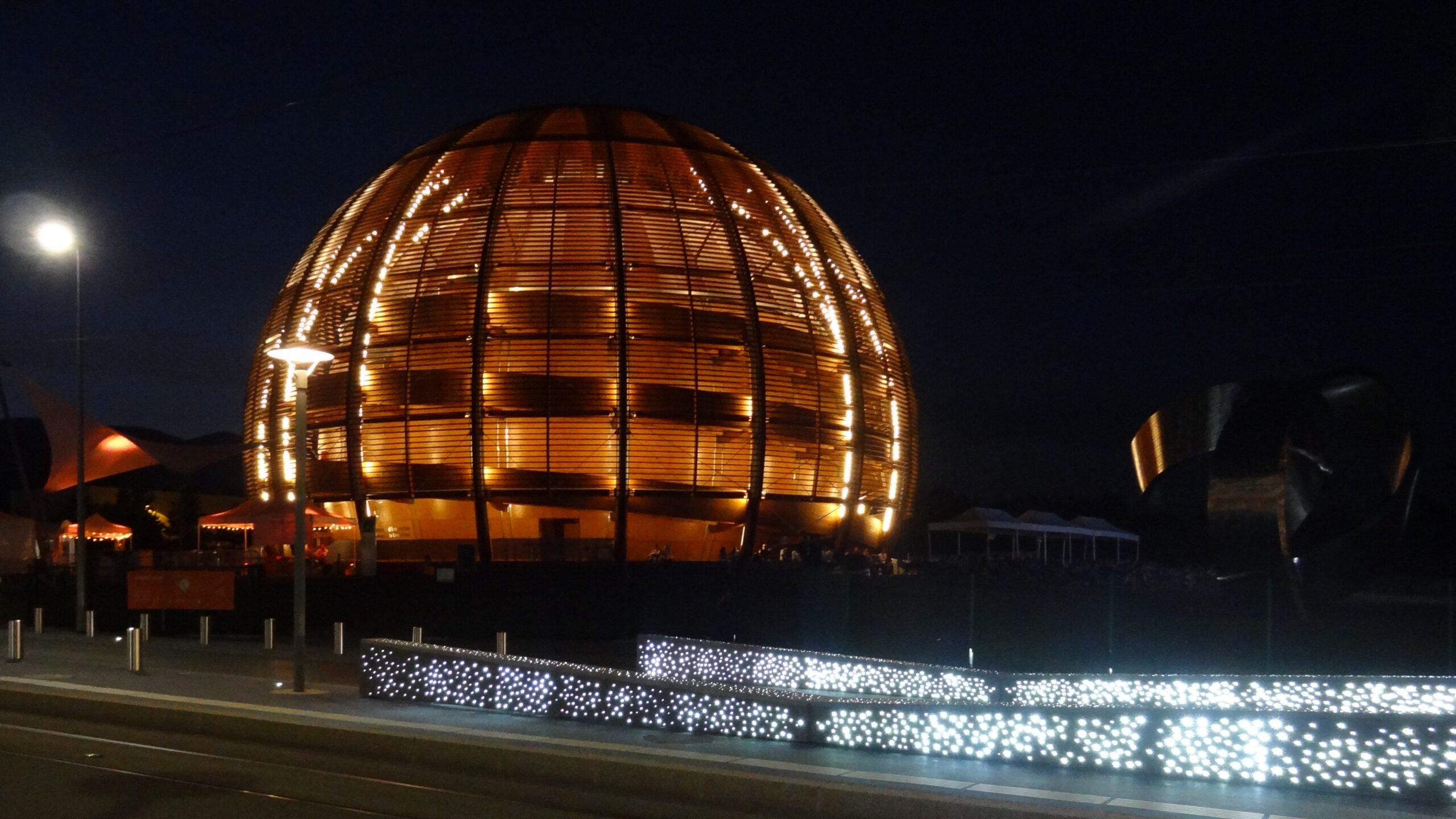
Biswajit Karmakar, Krzysztof Grzanka, Janusz Gluza, Bartosz Dziewit and Ievgen Dubovyk visited CERN from 29.05 to 18.06 as a part of the UŚ-CERN FCC scientific cooperation. In parallel we took part in the two-week Precision calculations for future e+e- colliders: targets and tools workshop, where Janusz Gluza gave a talk on Feynman parametrization and numerical integration.

We invite all students of the Faculty of Science and Technology of the University of Silesia to participate in lectures devoted to modern methods of calculating Feynman integrals and related general multidimensional integrals.
These lectures will be conducted by a recognized specialist in this field:
Dr. Gabor Somogyi.
They are organized within the framework of the POWER project.
Details on the project website.
We were at the secondary school LO1 in Rybnik: dr Biswajit Karmakar gave a lecture „Neutrinos and secrets of our Universe” with introduction by prof. Janusz Gluza „Wielkie urządzenia, małe obiekty – krótko o fizyce cząstek elementarnych” – “Big facilities, small objects – shortly about particle physics”. Some photos: link
Together with Bhupal Dev from Washington U. and Garv Chauhan from Louvain U. we prepared a report for the Snowmass 2021 which is on future plans in particle physics. Publication is available at https://inspirehep.net/literature/2052627
In October 2021, we welcomed a new member to our research team – Dr. Biswajit Karmakar, https://sites.google.com/view/biswate/
More details (in Polish): https://us.edu.pl/instytut/ifiz/dr-biswajit-karmakar-dolaczyl-na-trzy-lata-do-zespolu-badawczego-instytutu-fizyki-us
Janusz Gluza was a guest at 5th edition of Silesian Science Festival KATOWICE, where he presented a lecture on the role of symmetry in science, https://youtu.be/hukW8GWrSP4?t=440
Members of our research group took part in the 47th Congress of Polish Physicists organized by Polish Polish Physical Society in Bydgoszcz. Janusz Gluza, Bartosz Dziewit, Krzysztof Grzanka and Wojciech Flieger presented lectures while Karolina Skrzydelska and Szymon Zięba – posters.



About Us
The research is carried out in several directions, with an emphasis on precise calculations of higher-order perturbation effects for electroweak observables at LHC and future lepton accelerators. We are particularly focused on the activities related to the FCC-ee project at CERN.
The research topics of the group include:
1. Precise calculation of parameters and observables of the Standard Model (SM)
2. Phenomenology of SM extensions (neutrinos, additional gauge bosons, Higgs scalars)
3. Development of methods and tools for the calculation of multi-loop Feynman integrals
Detailed research goals:
1. Use of new computational techniques and advanced algebra to define and constraint elements of the neutrino mixing matrix with non-standard neutrinos.
2. Phenomenology of non-standard particles at the LHC and future lepton accelerators (H++, W2, Z2, heavy neutrinos).
Precise calculation of electroweak of electroweak pseudoobservables for the LHC and future accelerators.
3. Developing analytical and numerical methods of calculating multi-loop integrals.
4. Analysis of masses and mixing matrices in models with the so-called family symmetry.
5. Analysis of finite groups up to the order of 1025 assuming the existence of family symmetries for 3HDM models.
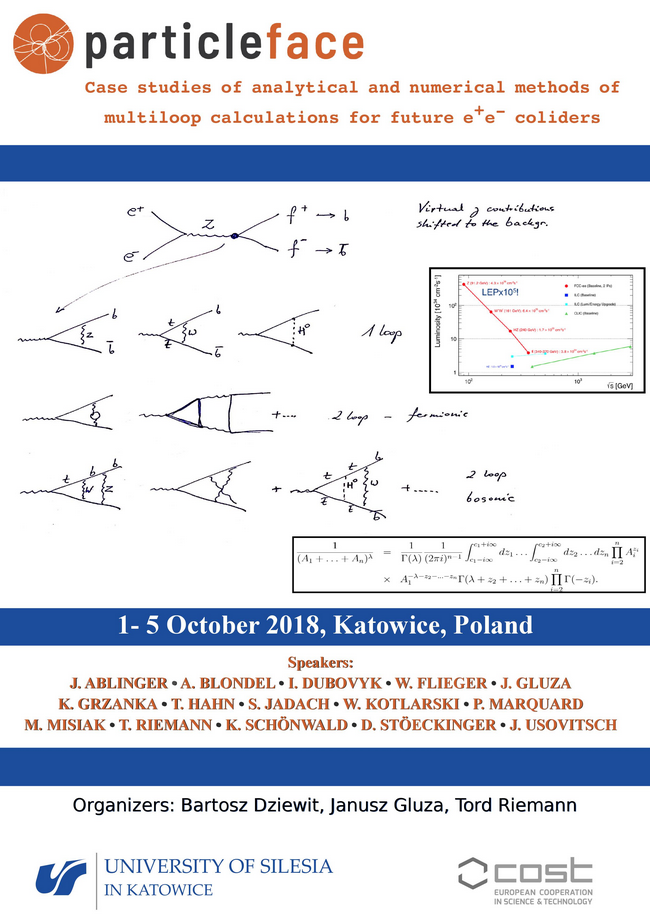
We organized PARTICLEFACE: Case studies of analytical and numerical methods of multiloop calculations for future e+e- colliders,
1-5 October 2018 Katowice, Poland https://indico.ific.uv.es/event/3357/overview